Pages

Showing posts with label News. Show all posts

The Man Who Lives Without Money

Mark Boyle outside his off-grid caravan.
Photograph: Mark Boyle
Think you couldn’t live without money? Irishman Mark Boyle challenged this notion and here’s how he finds life with no financial income, bank balance, and no spending.

“If someone told me seven years ago, in my final year of a business and economics degree, that I’d now be living without money, I’d have probably choked on my microwaved ready meal.” According to Boyle, the plan back then was to ‘get a good job’, make as much money as possible, and buy the stuff that would show society he was successful.

Like most individuals raised in a consumer-driven society, he never second guessed those goals. For a while he had a fantastic job managing a big organic food company and even had a yacht in the harbor. If it hadn’t have been for the chance purchase of a video called Gandhi, he’d still be pursuing the same life. “I’d still be doing it today. Instead, for the last fifteen months, I haven’t spent or received a single penny. Zilch”.

The change in life path came one evening on the yacht while philosophizing with a friend over a glass of Merlot. “Whilst I had been significantly influenced by Mahatma’s quote “be the change you want to see in the world”, I had no idea what that change was up until then.”

The two friends began talking about all the major issues in the world – environmental destruction, resource wars, factory farms, sweatshop labor – and wondered which of the issues they could best devote their time to. Mark didn’t feel he could really make any difference, however “being two small drops in a highly polluted ocean”.

That evening, though, a revelation came through: “These issues weren’t as unrelated as I had previously thought – they had a common root cause. I believe the fact that we no longer see the direct repercussions our purchases have on the people, environment, and animals they affect is the factor that unites these problems.”

Boyle believes that the degrees of separation between the consumer and the consumed have increased so much that it now means most people are completely unaware of the levels of destruction and suffering embodied in the ‘stuff’ they buy.

It can be agreed that few people actually want to cause suffering to others; most just don’t have any idea that they directly are. The tool that has enabled this separation is money, especially in its globalized format.

“If we grew our own food, we wouldn’t waste a third of it today” is one of Mark’s examples as to why it’s important a reconnection with natural/source living is established. “If we made our own tables and chairs, we wouldn’t throw them out the moment we changed the interior décor. If we had to clean our own water, we probably wouldn’t shit in it”.

The above arguments all honestly assess the undervalue most objects now have. With convenience at our fingertips, most don’t consider where their trash product or unwanted items go.

Deciding to be the change, this then spurred Mark to fully dive into his new viewpoint and give up money, which he only planned on doing for a year. “I made a list of the basics I’d need to survive. I adore food, so it was at the top. There are four legs to the food-for-free table: foraging wild food, growing your own, bartering and using waste grub, of which there are far more”.

On his first day, he fed 150 people a three-course meal with waste and foraged food. For himself, however, he ate his own crops and waste only made up about 5% of his diet. “I cooked outside – rain or shine – on a rocket stove”.

The next concern was shelter. He found himself a caravan from Freecycle, parked it on an organic farm he volunteered with, and renovated it out to be off the electricity grid. I’d use wood I either coppiced or scavenged to heat my humble abode in a wood burner made from an old gas bottle, and I had a compost loo to make ‘humanure’ for my veggies”. Up front and to the point, Boyle clearly understood the necessity of using every available resource to be most sustainable.

“I bathed in a river, and for toothpaste I used washed up cuttlefish bone with wild fennel seeds, an oddity for a vegan. For loo I’d relieve the local newsagent of its papers (Once I wiped my arse with a story about myself); it wasn’t double quilted but it quickly became normal”. For transportation, Mark used his bike and trailer, using the 55 km commute to the city as an alternative solution for the gym. Beeswax candles served as his lighting.

Humorously inspiring to some, deluded and anti-capitalist to others, Mark had this to say about his radical lifestyle: “Many people label me as anti-capitalist. Whilst I do believe capitalism is fundamentally flawed, requiring infinite growth on a finite planet, I am not anti anything.” More than anything, Boyle claims to be pro-nature, pro-community, and pro-happiness. How often is that a city dweller’s life philosophy?

“And that’s the thing I don’t get – if all this consumerism and environmental destruction brought happiness, it would make some sense. But all the key indicators of unhappiness – depression, crime, mental illness, obesity, suicide and so on are on the increase.” More money, it seems, does not equate to more happiness. (See Documentary: Happy)

Another positive effect of Mark’s unique lifestyle is the joy he has created for himself. “Ironically, I have found this year to be the happiest of my life. I’ve more friends in my community than ever, I haven’t been ill since I began, and I’ve never been fitter. I’ve found that friendship, not money, is real security. That most western poverty is spiritual, and that independence is really interdependent.”

Mark’s example certainly stands as inspiration for those seeking freedom from the fast-paced modern age; most alternative media sources would agree that the more one reconnects to nature, the better their mental, physical, and spiritual health is. However, could everyone live like this? According to Mark, no.

“It would be a catastrophe, we are too addicted to both it and cheap energy, and have managed to build an entire global infrastructure around the abundance of both.”

The prospect of gradually transitioning to re-localized, small communities is a possibility, though. With greener energy sources and healthier communities being implemented at a growing rate, natural living is already a reality, but may be made much more mainstream in the future to come.

“For over 90 percent of our time on the planet, a period when we lived much more ecologically, we lived without money. Now we are the only species to use it, probably because we are the species most out of touch with nature.”

Asked what was missing from his old world of lucre and business, Mark replied “Stress. Traffic-jams. Bank statements. Utility bills. Oh yeah, and the odd pint of organic ale with my mates down at the local”.

It just goes to show, if you are passionate about anything, you can be that change you’d like to see in the world.


Sources:

World Observer
The Guardian

True Activist

There Is An Upside-Down House In Russia

Yep, that means you walk on the ceiling and look up to the floor.

This is a house in Moscow. It’s the wrong way round.

This is a house in Moscow. It's the wrong way round.

It’s part of the “Upside Down House” show at the All-Russia Exhibition Center.

It's part of the "Upside Down House" show at the All-Russia Exhibition Center .

Visitors can explore the kitchen…

Visitors can explore the kitchen...

… the bedroom…

... the bedroom...

… and the bathroom.

... and the bathroom.

Flipping the photos makes it looks like they’re defying gravity.

Flipping the photos makes it looks like they're defying gravity.

Which is very cool.

Which is very cool.

Best. House. Ever.

Best. House. Ever.


(Source)

How Animals React To These 2 Little Boys Is Nothing Short Of Magical. I’m Speechless.

Elena Shumilova is a mother from from Andreapol, Russia, that has been taking stunning photos of her sons with animals. Now, those photos are making their way around the internet. The photos, hosted on 500px, aren’t just cute (although they definitely are). They show a connection between children and animals that, as adults get older, we forget about. It’s magical.

Yaroslav and Vanya are precious animal whisperers. There is something so relaxing about these photos, I could look at them all day, dreaming that I lived in their world. To see more of her wonderful photos, visit her 500px profile.


Source: 500px.com / Follow Elena on Facebook Here, viralnova.com
Share Elena’s work with others by clicking below.

13-year-old inventor cracks the secret of trees to revolutionize solar energy


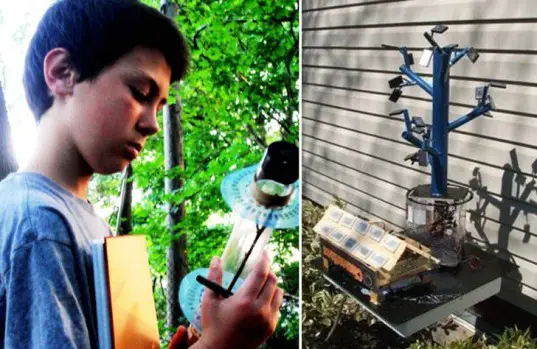
http://themindunleashed.org/wp-content/uploads/2014/01/solarr.jpgA 13-year-old boy named Aidan Dwyer has an idea that can vastly improve solar energy technology. His idea is so revolutionary that it might make flat panel solar designs extinct.

Aidan discovered a spiral mathematical formula in trees based on the Fibonacci sequence. When he recognized this design in the placement of tree branches, he began applying the secret knowledge to solar panel designs. His discovery could maximize solar panel sunlight collection in new, efficient ways.

Discovering a pattern in tree trunks

On a winter hiking trip, Aidan noticed something unique about tree branches. After collecting photographs of various trees, he began to see a pattern among the random display of branches and leaves. Aidan realized that the overall branch pattern of trees resembled a spiral. Furthermore, he found a mathematical pattern behind the spiral of branches. To investigate further, he began building test models.

Using the Fibonacci sequence to maximize sunlight collection

Upon investigating, Aidan discovered a pattern based on a number sequence invented by medieval mathematician Fibonacci. Fibonacci discovered a pattern when experimenting with a math puzzle. Through solving a problem about the rate at which rabbits reproduce over time, Fibonacci invented a sequence of numbers. Fibonacci invented a mathematical pattern, starting with zero and one. By adding two numbers to the series together, the new sum became the next number in the sequence. This sequence starts out with the numbers 1, 1, 2, 3, 5, 8, 13 and 21.

This Fibonacci sequence and its ratios appear in nature, in many forms of life. According to Aidan, examples of this pattern can be found in the seeds of a sunflower, systems of the human body and even galaxies in space.

Aidan found that tree trunks contain similar patterns based on the Fibonacci sequence.
According to Aidan, "Tree branches follow a Fibonacci formula." He reports that, in an oak tree, branches are arranged in a two to five sequence. "Five branches spiral around the trunk two times to reach the same starting point on the trunk," he reports.

The patterns that he found also include the elm tree, which follows a one to two pattern, and the beech tree, which follows a one to three pattern. He found a three to eight pattern in the willow tree and a five to one pattern in the branch arrangement of almond trees.

Using the spiral pattern for maximum efficiency in solar panel technology

In trying to understand the meaning behind the pattern, Aidan hypothesized that the main goal of the leaves is to collect maximum sunlight for photosynthesis.

To test this hypothesis, Aidan created mini tree models with sunlight-collecting solar panels. He arranged the mini panels in a spiral pattern based on the Fibonacci sequence design he observed in the trees.

Logging data on voltage and current, Aidan ran tests on the spiral design and on a flat panel design for several months. Click here to view his models.

He found out that the Fibonacci solar panel design was extremely more efficient than flat panel designs. The spiral patterns collect, on average, 20 percent more open current voltage and absorbs 2.5 more hours of sunlight per day.

Even more exciting were his results during the winter solstice when the sun is at its lowest point in the sky. During this time, the Fibonacci design collected 50 percent more sunlight than flat panel designs!

"My results suggest that the Fibonacci pattern can improve solar panel arrays in several ways. It collects more sunlight when the sun is at a low angle in the sky. This is useful during winter months and in extreme latitudes," Aidan explained.

He mentioned other benefits of the spiral design, saying that it will take up less room in urban areas, where space is limited. He also believes that the design would not collect as much rain and snow and be more weather-resistant than rooftop flat panel designs.

(Source)


21 Habits of Happy People

“Happiness is a habit – cultivate it.” ~ Elbert Hubbard

Happiness is one aspiration all people share. No one wants to be sad and depressed.

We’ve all seen people who are always happy – even amidst agonizing life trials. I’m not saying happy people don’t feel grief, sorrow or sadness; they just don’t let it overtake their life. The following are 21 things happy people make a habit of doing:

1. Appreciate Life

Be thankful that you woke up alive each morning. Develop a childlike sense of wonder towards life. Focus on the beauty of every living thing. Make the most of each day. Don’t take anything for granted. Don’t sweat the small stuff.

2. Choose Friends Wisely
Surround yourself with happy, positive people who share your values and goals. Friends that have the same ethics as you will encourage you to achieve your dreams. They help you to feel good about yourself. They are there to lend a helping hand when needed.

3. Be Considerate
Accept others for who they are as well as where they are in life. Respect them for who they are. Touch them with a kind and generous spirit. Help when you are able, without trying to change the other person. Try to brighten the day of everyone you come into contact with.

4. Learn Continuously
Keep up to date with the latest news regarding your career and hobbies. Try new and daring things that has sparked your interest – such as dancing, skiing, surfing or sky-diving.

5. Creative Problem Solving
Don’t wallow in self-pity. As soon as you face a challenge get busy finding a solution. Don’t let the set backs affect your mood, instead see each new obstacle you face as an opportunity to make a positive change. Learn to trust your gut instincts – it’s almost always right.

6. Do What They Love
Some statistics show that 80% of people dislike their jobs! No wonder there’s so many unhappy people running around. We spend a great deal of our life working. Choose a career that you enjoy – the extra money of a job you detest isn’t worth it. Make time to enjoy your hobbies and pursue special interests.

7. Enjoy Life
Take the time to see the beauty around you. There’s more to life than work. Take time to smell the roses, watch a sunset or sunrise with a loved one, take a walk along the seashore, hike in the woods etc. Learn to live in the present moment and cherish it. Don’t live in the past or the future.

8. Laugh
Don’t take yourself – or life to seriously. You can find humor in just about any situation. Laugh at yourself – no one’s perfect. When appropriate laugh and make light of the circumstances. (Naturally there are times that you should be serious as it would be improper to laugh.)

9. Forgive
Holding a grudge will hurt no one but you. Forgive others for your own peace of mind. When you make a mistake – own up to it – learn from it – and FORGIVE yourself.

10. Gratitude
Develop an attitude of gratitude. Count your blessings; All of them – even the things that seem trivial. Be grateful for your home, your work and most importantly your family and friends. Take the time to tell them that you are happy they are in your life.

11. Invest in Relationships
Always make sure your loved ones know you love them even in times of conflict. Nurture and grow your relationships with your family and friends by making the time to spend with them. Don’t break your promises to them. Be supportive.

12. Keep Their Word
Honesty is the best policy. Every action and decision you make should be based on honesty. Be honest with yourself and with your loved ones.

13. Meditate
Meditation gives your very active brain a rest. When it’s rested you will have more energy and function at a higher level. Types of meditation include yoga, hypnosis, relaxation tapes, affirmations, visualization or just sitting in complete silence. Find something you enjoy and make the time to practice daily.

14. Mind Their Own Business
Concentrate on creating your life the way you want it. Take care of you and your family. Don’t get overly concerned with what other people are doing or saying. Don’t get caught up with gossip or name calling. Don’t judge. Everyone has a right to live their own life the way they want to – including you.

15. Optimism
See the glass as half full. Find the positive side of any given situation. It’s there – even though it may be hard to find. Know that everything happens for a reason, even though you may never know what the reason is. Steer clear of negative thoughts. If a negative thought creeps in – replace it with a positive thought.

16. Love Unconditionally
Accept others for who they are. You don’t put limitations on your love. Even though you may not always like the actions of your loved ones – you continue to love them.

17. Persistence
Never give up. Face each new challenge with the attitude that it will bring you one step closer to your goal. You will never fail, as long as you never give up. Focus on what you want, learn the required skills, make a plan to succeed and take action. We are always happiest while pursuing something of value to us.

18. Be Proactive
Accept what can not be changed. Happy people don’t waste energy on circumstances beyond their control. Accept your limitations as a human being. Determine how you can take control by creating the outcome you desire – rather than waiting to respond.

19. Self Care
Take care of your mind, body and health. Get regular medical check ups. Eat healthy and work out. Get plenty of rest. Drink lots of water. Exercise your mind by continually energizing it with interesting and exciting challenges.

20. Self Confidence
Don’t try to be someone that you’re not. After all no one likes a phony. Determine who you are in the inside – your own personal likes and dislikes. Be confident in who you are. Do the best you can and don’t second guess yourself.

21. Take Responsibility
Happy people know and understand that they are 100% responsible for their life. They take responsibility for their moods, attitude, thoughts, feelings, actions and words. They are the first to admit when they’ve made a mistake.

Begin today by taking responsibility for your happiness. Work on developing these habits as you own. The more you incorporate the above habits into your daily lifestyle – the happier you will be.

Most of all: BE TRUE TO YOURSELF.

Man Builds Fairy Tale Home for His Family – Total Cost £3,000


Man-Builds-Fairy-Tale-Home

Simon Dale is a family man in Wales, the western part of Great Britain. His interest in self-sustainability and an ecological awareness led him to dig out and build his own home—one of the loveliest, warmest, most inviting dwellings you could ever imagine. And it cost him only £3,000, about $4,700 American dollars!


Can you imagine a more charming entrance than this?

Hobbit Home
Hobbit Home Interior

Simon gives two reasons for building the home. The first elegant one, from his website, is:
It’s fun. Living your own life, in your own way is rewarding. Following our dreams keeps our souls alive.
His second reason is a plea for sustainability, in which he states that “our supplies are dwindling and our planet is in ecological catastrophe”. You can read the full and passionate statement here.
Simon is also a photographer, and as you can see throughout this article, a talented one.

A beautiful view in another home that Simon is helping build for someone else. (Originally, this was mistakenly identified as a photo of the home he and his family are living in.)

A beautiful view in another home that Simon is helping build for someone else. (Originally, this was mistakenly identified as a photo of the home he and his family are living in.)

The tools are fairly simple. The main concession to modernity was a chainsaw, which he used to cut down about 30 small trees. No old growth forest fell to his family’s needs. He focused on tools that used his own energy, like shovel, chisel, and hammer. Yet it took him only four months to produce this lovely home.
Hobbit Home Stove and Play Area

The home is constructed from wood, stone, straw, and has a sod roof. It’s heated with a wood fireplace and has a solar panel for power. Most materials were scavenged and refurbished appliances. The effect, though, isn’t of a run-down get-by-with-second-best . It’s creative, artistic, elegant, and cozy. It is, in fact, magical.

Most amazingly, the home didn’t require years of training or experience. Simon had none. He’s not an architect. He’s not an engineer. He’s not a carpenter.  He started from scratch in every sense. He told the Daily Mail:
Being your own have-a-go architect is a lot of fun and allows you to create and enjoy something which is part of yourself and the land rather than, at worst, a mass-produced box designed for maximum profit and the convenience of the construction industry.

Building from natural materials does away with producers’ profits and the cocktail of carcinogenic poisons that fill most modern buildings.
Hobbit Home


He was fortunate in obtaining the land for his home. The plot, a bit of a large piece, was given to him in exchange for its caretaking.

Hobbit Home View from LoftHobbit Home Outside

Simon Dale, his wife Jasmine Saville, and their two children in front of their completed home just 4 months after starting it! This and all photos on this page are by Simon Dale (http://simondale.net).

The attention to making the home eco-friendly extends to a compost toilet, the use of straw over a plastic layer for insulation, and a refrigerator that’s cooled with air that flows from under the home’s foundation.

Cement is a high carbon emitter, so the interior walls are finished with lime plaster instead of cement plaster.
Hobbit Home Plan

Simon is now involved in building another home for the Lammas Project, an organization dedicted to low-impact building. Focus is not only on the homes themselves, but also on planting trees and gardens, and on low impact living in general. Here’s how he sums up his view on his home and the Lammas Project:
This building is one part of a low-impact or permaculture approach to life. This sort of life is about living in harmony with both the natural world and ourselves, doing things simply and using appropriate levels of technology. These sort of low cost, natural buildings have a place not only in their own sustainability, but also in their potential to provide affordable housing which allows people access to land and the opportunity to lead more simple, sustainable lives.
I cannot imagine a home more lovely, appealing, and livable than this one. This could be and should be the wave of the future in home building.

For more information about Simon Dale’s home, plans, and more photos, please go to his website, A Low Impact Woodland Home.

Simon Dale, his wife Jasmine Saville, and their two children.

Sources: gaia-health

A Rich Woman Abandoned This Apartment In 1942. What They Just Found Inside Is Incredible.

Madame de Florian was a French socialite and actress who fled to the south of France during World War II. She kept her apartment in Paris on the Right Bank near the Opéra Garnier, though, in case she wanted to return. However, she never went back to it after the war. Since 1942, the apartment has been sitting untouched, until recently when an auctioneer entered her apartment. What he found was a time capsule, full of treasures.

Stepping into this apartment is like stepping into history.

The apartment was able to remain abandoned and untouched because Madame de Florian continued paying the rent until her death in 2010 at the age of 91. Despite paying the rent, she never returned.


Source: belloblog.com

Richest 300 Persons on Earth Have More Money Than Poorest 3 Billion

Poor rummage through garbage to survive in the Philippines
As we repeatedly focus on wealth inequality in the United States (i.e.; just four hundred persons in the US have as much in assets and income as the bottom 50% of Americans), a video points out the even more extreme global wealth disparity.

There are many reasons for this.  Take for example institutional sources that contribute to this trend.  The World Bank, for interest, oversees "loans" to developing nations.  But by creating long-term indebtedness, these struggling counties end up owing at least $600 billion dollars in interest on loans whose principals have, in essence, already been paid off in actual dollars.

These usorious interest rates end up in the hands of the bankers and the shareholders of the financial institutions that are inter-related with the World Bank through the nations that govern it, particularly the United States which calls the shots.  Criticisms of the World Bank focus on how it creates financial conditions that result in debt dependency of the nations that borrow from it, therfore negatively impacting the economic prospects of the vast majority of its residents.

Trade agreements and global corporate exploitation of international monetary regulations provide resources and cheap labor to developed nations, while leaving poorer countries depleted. Is it possible that rich countries have increased the wealth gap from being 35 times greater during European colonialization to 80 times greater today? The video Global Wealth Equality contends that is the case.

This are just somes examples of how the economic cards are stacked by the G-8 and G-20 through the institutional and global corporate creation and manipulation of the financial rules. But when you move to the impact of global wealth distribution to individuals, according to Global Wealth Equality, the richest 1% on the earth have accumulated some 43% of the world's wealth, while the bottom 80% of the planet's inhabitants have just 6% between them.

There is an increasing wealth gap of immense proportions in the United States.  For decades, the nation's assets have grown more and more concentrated in the hands of a few, while the rest of the nation makes do with the crumbs.

This skewed economic distribution within the US is reflective of an even worse economic disparity in the world in general.

The post-colonial era has actually accelerated economic injustice on a worldwide basis. What's done in the name of helping the world's poor (by the World Bank and the International Monetary Fund) is often really only a process of capturing markets too weak to fight back and indebting them to the masters of wealth without recourse. This has become abundantly clear in the World Bank's policies of "structural adjustment" for the developing world, which might be best phrased as "you pay us the interest on our loans and impose austerity on yourselves. It will be good for you."

Sound familiar?


(Source)

Indian man single-handedly plants a 1,360-acre forest

Jadav Payeng turned a barren sandbar in northern India into a lush new forest ecosystem.

A little more than 30 years ago, a teenager named Jadav "Molai" Payeng began burying seeds along a barren sandbar near his birthplace in northern India's Assam region to grow a refuge for wildlife. Not long after, he decided to dedicate his life to this endeavor, so he moved to the site so he could work full-time creating a lush new forest ecosystem. Incredibly, the spot today hosts a sprawling 1,360 acres of jungle that Payeng planted — single-handedly.

The Times of India recently caught up with Payeng in his remote forest lodge to learn more about how he came to leave such an indelible mark on the landscape.

It all started way back in 1979, when floods washed a large number of snakes ashore on the sandbar. One day, after the waters had receded, Payeng, only 16 then, found the place dotted with the dead reptiles. That was the turning point of his life.
 
"The snakes died in the heat, without any tree cover. I sat down and wept over their lifeless forms. It was carnage. I alerted the forest department and asked them if they could grow trees there. They said nothing would grow there. Instead, they asked me to try growing bamboo. It was painful, but I did it. There was nobody to help me. Nobody was interested," says Payeng, now 47.
 
While it's taken years for Payeng's remarkable dedication to planting to receive some well-deserved recognition internationally, it didn't take long for wildlife in the region to benefit from the manufactured forest. Demonstrating a keen understanding of ecological balance, Payeng even transplanted ants to his burgeoning ecosystem to bolster its natural harmony. Soon the shadeless sandbar was transformed into a self-functioning environment where a menagerie of creatures could dwell. The forest, called the Molai woods, now serves as a safe haven for numerous birds, deer, rhinos, tigers and elephants — species increasingly at risk from habitat loss.
 
Despite the conspicuousness of Payeng's project, forestry officials in the region first learned of this new forest in 2008 — and since then they've come to recognize his efforts as truly remarkable, but perhaps not enough.
 
"We're amazed at Payeng," says Gunin Saikia, assistant conservator of Forests. "He has been at it for 30 years. Had he been in any other country, he would have been made a hero."


Source: www.mnn.com

If You Don’t Believe in Miracles, You Should Probably See This.

A woman driving in the Jiangsu Province of China survived an accident that no one else would have been able to. A container on a semi fell over, crushing her car. Onlookers believed her to be dead… and rescue workers were SHOCKED when they heard her cry for help.

It’s a miracle she survived this crash – and it’s absolutely unbelievable that she walked away from it.

Source